Handley Page HP.67 Hastings
4-Engine Low-Wing Taildragger Monoplane Transport, UK
Archive Photos 1
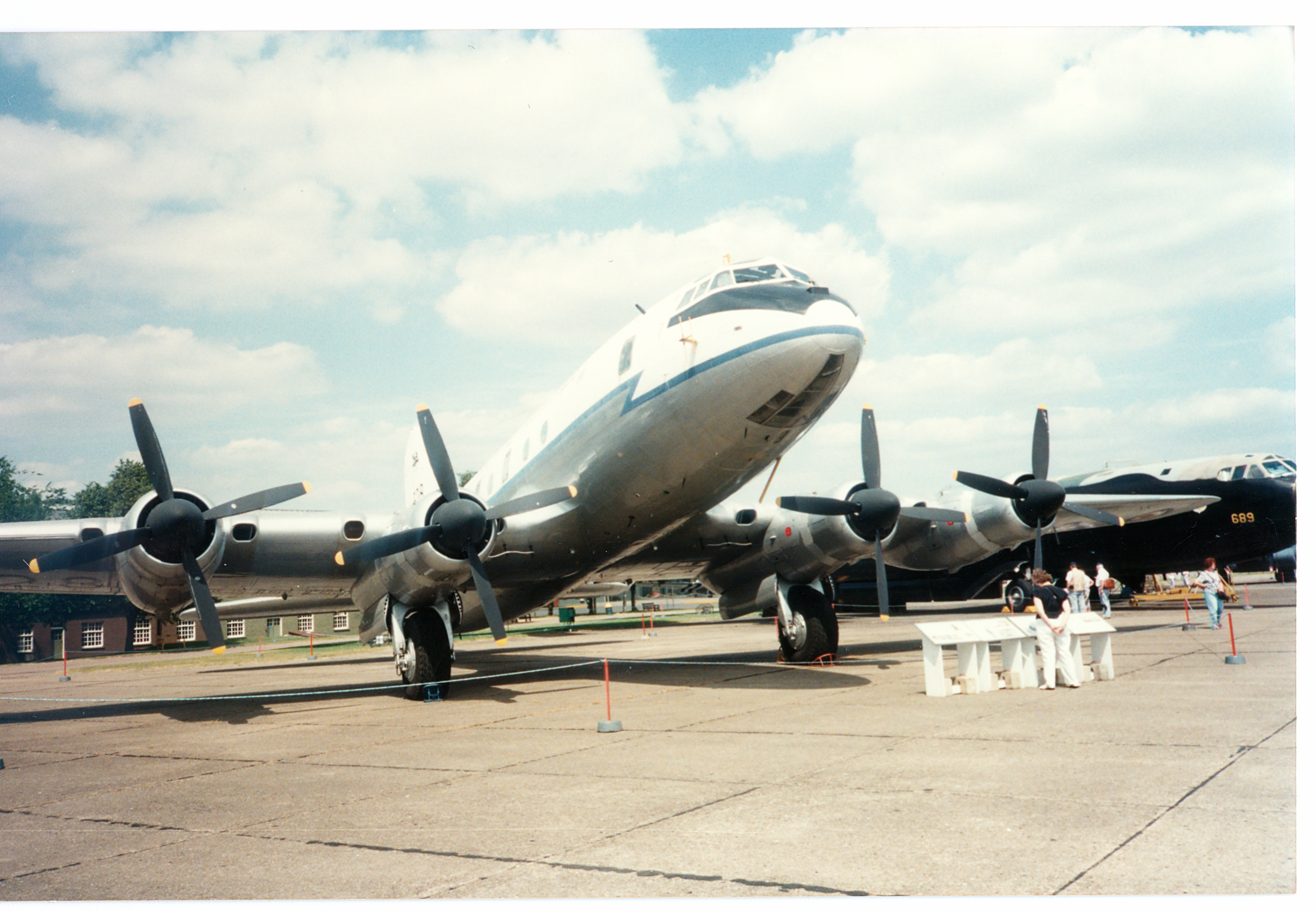
Handley Page HP.67 Hastings C.1A (TG528) on display (c.1994) at the Imperial War Museum Duxford, Cambridgeshire, England

Overview 2
- Handley Page HP.67 Hastings
- Role: Transport aircraft
- Manufacturer: Handley Page
- First flight: 7 May 1946
- Introduction: September 1948
- Retired: 1977 (RAF)
- Primary users: RAF; RNZAF
- Produced: 1947 - 1952
- Number built: 151
- Variants: Handley Page Hermes
The Handley Page H.P.67 Hastings was a British troop-carrier and freight transport aircraft designed and built by Handley Page Aircraft Company for the Royal Air Force. At the time, it was the largest transport plane ever designed for the RAF, and it replaced the Avro York as the standard long-range transport.
Design and Development 2
Handley Page’s answer to meet Air Staff Specification C.3/44 for a long-range general purpose transport was the HP.67. It was an all-metal low-wing cantilever monoplane with conventional tail unit. It had all-metal tapering dihedral wings, which had been designed for the abandoned HP.66 bomber development of the Handley Page Halifax and a circular fuselage suitable for pressurization up to 5.5 psi (38 kPa). It had a retractable undercarriage and tailwheel. The Hastings was powered by four wing-mounted Bristol Hercules 101 sleeve valve radial engines. In service the aircraft was operated by a crew of five and could accommodate either 30 paratroopers, 32 stretchers and 28 sitting casualties, or 50 fully equipped troops.
A civilian version of the Hastings was developed as the Handley Page Hermes. The Hermes prototypes were given priority over the Hastings but the program was put on hold after the prototype crashed on its first flight on 2 December 1945 and the company concentrated on the military Hastings variant. The first of two Hastings prototype (TE580) flew at RAF Wittering on 7 May 1946. Tests showed that the aircraft was laterally unstable and that it had poor stall warning capabilities. The prototypes and first few production aircraft were subject to a series of urgent modifications and testing to resolve these problems. A temporary solution was found by modifying the tailplane with 15° of dihedral, while being fitted with synthetic stall warning. This allowed the first production aircraft (Hastings C.1) to enter service in October 1948.
The RAF initially ordered 100 Hastings C.1 aircraft but the last six were built as weather reconnaissance versions as the Hastings Met. Mk.1, and seven other aircraft were converted to this standard. Eight C.1 aircraft were later converted to Hastings T.5 trainers which were used for training the V-bomber crews; three at a time.
While tail modifications introduced to the C.1 allowed it to enter service, a more definitive solution was the fitting of an extended-span tailplane, which was mounted lower on the fuselage. These changes, together with the fitting of additional fuel tanks in the outer wing, resulted in the C.Mk.2, while a further modified VIP transport, fitted with yet more fuel to give a longer range became the C.Mk.4.
A total of 147 aircraft were built for the Royal Air Force and four for the Royal New Zealand Air Force, a total of 151.
Operational History 2
The Hastings was rushed into service because of the Berlin Airlift, with No. 47 Squadron replacing its Halifax A.Mk.9’s with Hastings in September-October 1948, flying its first sortie to Berlin on 11 November 1948. The Hastings fleet was mainly used to carry coal, with two further squadrons, 297 and 53 joining the airlift before its end. A Hastings made the last sortie of the airlift on 6 October 1949, the 32 Hastings deployed delivering 55,000 tons (49,900 tonnes) of supplies for the loss of two aircraft.
One hundred Hastings C.Mk.1 and 41 Hastings C.Mk.2 were built, and they served both on Transport CommanD’s long-range routes and as a tactical transport until well after the arrival of the Bristol Britannia in 1959. An example of the latter use was during the Suez Crisis when Hastings of 70, 99 and 511 Squadrons dropped paratroopers on El Gamil airfield.
Hastings continued to provide transport support to British military operations around the globe through the 1950s and 1960s, including dropping supplies to troops opposing Indonesian forces in Malaysia during the Indonesian Confrontation.
The Hastings was retired from Royal Air Force Transport Command in early 1968 when it was replaced by the Lockheed Hercules. The Met Mk.1 weather reconnaissance aircraft were used by No. 202 Squadron RAF at RAF Aldergrove, Northern Ireland from 1950 until the Squadron was disbanded on 31 July 1964, being made obsolete by weather satellites. The Hastings T.Mk.5 remained in service as radar trainers well into the 1970s, even being used for reconnaissance purposes during the Cold War in the winter of 1975-76, finally being retired on 30 June 1977.
Hastings were also operated in New Zealand, where the Royal New Zealand Air Force’s 40 Squadron flew the type until replaced by C-130 Hercules in 1965. Four Hastings C.Mk.3 transport aircraft were built and supplied to the RNZAF. One crashed at RAAF Base Darwin and caused considerable damage to the city’s water main, its railway and the road into the city. The other three were broken up at RNZAF Base Ohakea. During the period that the engines were having problems with their sleeve valves (lubricating oil difficulties) RNZAF personnel joked that the Hastings was the best three-engined aircraft in the world.
Variants 2
- HP.67 Hastings: Prototype, two built.
- HP.67 Hastings C.1: Production aircraft with four Bristol Hercules 101 engines, 94 built all later converted to C.1A and T.5.
- HP. 67 Hastings C.1A: C.1 rebuilt to C.2 standard.
- HP.67 Hastings Met.1: Weather reconnaissance version for Coastal Command, six built.
- HP.67 Hastings C.2: Improved version with larger-area tailplane mounted lower on fuselage, increased fuel capacity and powered by Bristol Hercules 106 engines, 43 built and C.1’s were modified to this standard as C.1A’s.
- HP.95 Hastings C.3: Transport aircraft for the RNZAF, similar to C.2 but had Bristol Hercules 737 engines, four built.
- HP.94 Hastings C.4: VIP transport version for four VIP’s and staff, four built.
- HP.67 Hastings T.5: Eight C.1’s converted for RAF Bomber Command with ventral radome to train V bomber crews on the Navigation Bombing System (NBS).
Operators 2
- New Zealand: Royal New Zealand Air Force, No. 40 and 41 Squadrons RNZAF
- United Kingdom: Royal Air Force. No. 24, 36, 47, 48, 51, 53, 59, 70, 97, 99, 114, 115, 116, 151, 202, 242, 297, and 511 Squadron RAF; Far East Communications Squadron RAF
Survivors 2
Four Hastings are preserved in the UK and Germany:
- TG503 (T.5) on display at the Alliiertenmuseum (Allied Museum), Berlin, Germany.
- TG511 (T.5) on display at the RAF Museum Cosford, England.
- TG517 (T.5) on display at the Newark Air Museum, Newark, England.
- TG528 (C.1A) on display at the Imperial War Museum, Duxford, England.
- NZ5801 (C.3) 1952. Nose/Cockpit section only of RNZAF Military Transport is preserved at Auckland New ZealanD’s Museum of Transport and Technology along with engines, props and an undercarriage assembly, which is functional for display purposes.
Accidents and Incidents 2
- 16 July 1949 - Hastings TG611 lost control during takeoff at Berlin-Tegel Airport and dived into the ground due to incorrect tail trim; all five crew died.
- 26 September - 1949 Hastings TG499 lost the belly pannier, which hit the tail causing the aircraft to crash; all three crew died.
- 20 December 1950 - Hastings TG574 lost a propeller in flight, which hit the fuselage killing the co-pilot. The aircraft diverted to Benina, Libya and the aircraft flipped onto its back during landing. A total of five out of the seven crew were killed but the 27 passengers (all "slip" crews returning) survived.
- 19 March 1951 - Hastings WD478 stalled on takeoff at RAF Strubby; 3 crew died.
- 16 September 1952 - Hastings WD492 had a whiteout and crashed at Northice, Greenland. All the crew rescued by USAF Rescue at Thule.
- 12 January 1953 - Hastings C.1 TG602 crashed after takeoff when both elevator and the tailplane broke away; all 5 crew and 4 passengers died.
- 22 June 1953 - Hastings WJ335 stalled and crashed on takeoff at RAF Abingdon. The elevator control locks had been left engaged. All six crew died.
- 23 July 1953 - Hastings TG564 crashed on landing at Kai Tak with one fatality on the ground and the aircraft completely burnt out. Flight was outward bound for a casualty evacuation operation from Korea to the United Kingdom.
- 2 March 1955 - Hastings WD484 stalled and crashed on takeoff at RAF Boscombe Down due to the elevator controls being locked; all 4 crew died.
- 9 September 1955 - Hastings NZ5804 lost power on three engines due to multiple birdstrike and crashed just after takeoff from Darwin, Australia. 25 crew and passengers survived.
- 13 September 1955 - Hastings TG584 lost control attempting to overshoot at RAF Dishforth and crashed; 5 died.
- 9 April 1956 - Hastings WD483 undercarriage collapsed on landing and crashed at landing. No fatalities.
- 29 May 1959 - Hastings TG522 stalled and crashed on approach to Khartoum Airport, Sudan, after engine failure. All 5 crew died, 25 passengers survived.
- 1 March 1960 - Hastings TG579 crash landed in the sea 1.5 miles East of Gan, Maldives in a violent tropical storm. All 6 crew and 14 passengers survived.
- 29 May 1961 - Hastings WD497 stalled and crashed in Singapore after an engine lost power; 13 died.
- 10 October 1961 - Hastings WD498 stalled and crashed on takeoff from RAF El Adem, Libya after the pilot’s seat slid back. Seventeen of the 37 occupants died.
- 17 December 1963 - Hastings C.1A TG610 engine failure during ’roller’ landing at Thorney Island, Sussex. Aircraft ran into, and destroyed, a radio servicing building, killing one of the occupants and injuring four. The crew was uninjured.
- 6 July 1965 - Hastings C.1A TG577, departing from RAF Abingdon on a parachute drop, crashed at Little Baldon, Oxfordshire, with the loss of 41 lives. The cause was metal fatigue of two of the elevator bolts.
- 4 May 1966 - Hastings TG575 was written off when undercarriage collapsed landing at El Adem, Libya.
Specifications Hastings C.1 2
General Characteristics
- Crew: 5-6
- Capacity: 50 troops
- Length: 81 ft 3 in (24.8 m)
- Wingspan:
- Height: 22 ft 6 in (6.9 m)
- Wing area: 1,408 ft² (130.8 m²)
- Empty weight: 41,689 lb (18,910 kg)
- Loaded weight: 75,000 lb (34,010 kg)
- Powerplant: 4 × Bristol Hercules 101 radial piston engine, 1,675 hp (1,250 kW) each
Performance
- Maximum speed: 343 mph (552 km/h) at 21,500 ft (6,550 m)
- Range: 2,850 mi (4,590 km)
- Service ceiling: 26,700 ft (8,140 m)
- Rate of climb: 1,010 ft/min (310 m/min)
- Wing loading: 53.3 lb/ft² (260 kg/m²)
- Power/mass: 0.089 hp/lb (0.147 kW/kg)
References
- Shupek, John. Photos, copyright © 2002 Skytamer Images. All Rights Reserved
- Wikipedia, the free encyclopedia, Handley Page Hastings